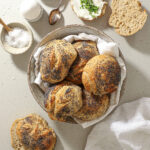
No-knead wholemeal Danish poppy seed rolls (håndværkere)
Recipe for easy no-knead, cold-proved håndværkere – wholemeal Danish poppy seed rolls.This recipe makes 8-10 rolls.
Servings 8 people
Calories 271kcal
Ingredients
- 400 ml cold water
- 12 g fresh yeast
- 2 tbsp olive oil
- 200 g wholemeal wheat flour or graham flour
- 325 g plain flour
- 12 g salt
- poppy seeds for the tops
Instructions
Day 1
- Mix the dough directly in the bowl it will rise in – make sure it is big enough for the dough to expand.I mix my dough in a 3-litre lidded plastic food container.
- Dissolve the yeast in the water, then add the oil, both flours and the salt.You may want to add the flour in a couple of batches – it makes the dough easier to stir together.
- Stir the dough thoroughly with a spoon, making sure all the flour and salt are worked into the dough. If needed, wet your hand with a little water and help the dough along.If the dough seems too firm, you can add up to 50 ml extra water – add it a little at a time. Different flours absorb different amounts of liquid.
- Put the lid on and leave the dough to rise on the worktop for about half an hour before putting it in the fridge overnight.
Day 2
- Take the dough out of the fridge and let it lose some of its chill while the oven heats up. Leave the dough in the container.A baking steel is ideal for these rolls and gives a really good result. The baking steel must heat up in the oven as it preheats.Alternatively, let the baking tray heat up in the oven.
- Dip a spoon in cold water, scoop up blobs of dough and place them on a sheet of baking paper.Continue until you have used up the dough and have 8-10 rolls, then sprinkle the tops with poppy seeds.If time allows, let the rolls prove for a further 20 minutes or so under a tea towel – but this is not a must.
- Bake the rolls at 230°C in a conventional oven (top and bottom heat) for about 18 minutes – until they are beautifully golden.Let the rolls cool slightly on a wire rack before serving.
- Afterwards, store them in a sealed bag – or freeze any that are left over.The rolls are easy to reheat over the weekend. Give them 5-8 minutes at 200°C, perhaps spritzed with a little water on top – and they are as good as freshly baked again.
Nutrition
Calories: 271kcal | Carbohydrates: 50g | Protein: 8g | Fat: 4g | Saturated Fat: 1g | Polyunsaturated Fat: 1g | Monounsaturated Fat: 3g | Sodium: 586mg | Potassium: 151mg | Fiber: 4g | Sugar: 0.4g | Vitamin C: 0.01mg | Calcium: 14mg | Iron: 3mg